
A vertical coming of age
There are few other verticals that can claim the same acceleration as esports. What was once considered a niche has become a critical performance driver for ambitious, forward-thinking operators. Kambi has reported that betting volume on its esoccer product has grown to become a top five sport by both number of bets and turnover – a milestone that underlines just how far the category has come in terms of market maturity. The category’s wider cultural relevance is exploding too, with 50 million tuning in to the League of Legends Worlds in 2024.
Anton Janér, founder and managing director of Abios (Kambi’s esports arm) believes this shift to the mainstream stems from a blend of audience growth and product maturity. “Esports has been far more than just a niche for some time,” he says. “Its growth is being driven not just by player demand, but by operators and suppliers redefining what an esports betting product can be.”
“This evolution has transformed esports into a sophisticated, fast-expanding vertical that can no longer be considered niche.”
That transformation, he adds, has been led by a relatively small group of data-focused providers. While many sportsbooks still treat esports as filler content and deliver a limited, serviceable offering, companies such as Kambi and Abios are setting new standards and advancing beyond the market through advanced modelling, innovative market types, and a goal to offer the same rich feature sets as on traditional sports.
Crucially, esports now provides the “always-on” content sportsbooks need to maintain engagement. Arguably, this offers operators a new means of driving ongoing customer interaction. The short, fast-paced format of esoccer and ebasketball fills calendar gaps, keeping engagement constant while offering familiar mechanics for traditional sports fans.
Building a foundation for scalability
Behind esports’ rise lies a significant technology story. Many operators have struggled to deliver competitive products due to a lack of dedicated data access and in-house expertise. Kambi’s 2021 acquisition of Abios addressed that challenge directly, bringing in what Janér calls “crucial esports DNA” and aligning the group with the steep growth curve of the vertical.
Abios arrived with established credentials, supplying data and infrastructure to betting operators, media companies, and esports teams alike. Within the Kambi network, its technology now powers a comprehensive offering that combines high-performance esports odds feeds with Bet Builder, player props, and diverse market types.
This offering is supported by access to official real-time tournament data from all relevant rights holders, ensuring both reliability of live coverage and higher uptime. The platform also includes data visualisation to deepen customer engagement, showing live scores, historical map performance and pre-match statistics tailored to each title.
The result is a system that supplies both the core betting product and the steady stream of “always-on” content, with esoccer and ebasketball matches typically lasting around 10 minutes. Combined with Kambi’s existing licensing and operational infrastructure, this depth of offering presents a structural advantage. As a result, the provider has now reported a 300% year-on-year increase in monthly events and a rapidly expanding coverage footprint across leading titles such as Counter-Strike 2, League of Legends and Dota 2.
Janér explains that the role of Abios as a dedicated esports division provides a significant operational benefit, ensuring focus. “No external priorities — whether it’s the World Cup or Super Bowl — will ever distract from our focus on evolving the esports product,” he says.
Matching a new generation’s expectations
A key challenge in esports betting has been the need to expand beyond a focus on coverage – with an expansion in product quality and customisation required to meet evolving demands. Today’s esports bettors are digital natives who expect the same interactivity and personalisation they find in mainstream entertainment apps.
Furthermore, the betting behaviour of the Gen-Z audience is notably different; they expect seamless navigation, prefer to engage on mobile devices, and expect unencumbered integration between content viewing and wagering.
User experience is increasingly the defining factor in operator success. Speed, therefore, is of the essence. The ability to offer features that match the complexity of the live gaming experience — such as combination bets cutting-edge live engagement underpinned by high-speed data — is essential for capturing and retaining this segment.
Kambi’s recently launched Counter-Strike 2 Bet Builder illustrates one way the company is responding to that demand. “The modelling behind our CS2 Bet Builder allows the same combinability seen in soccer or the NFL,” Janér says – unlocking a strength of UX not seen before in esports betting.
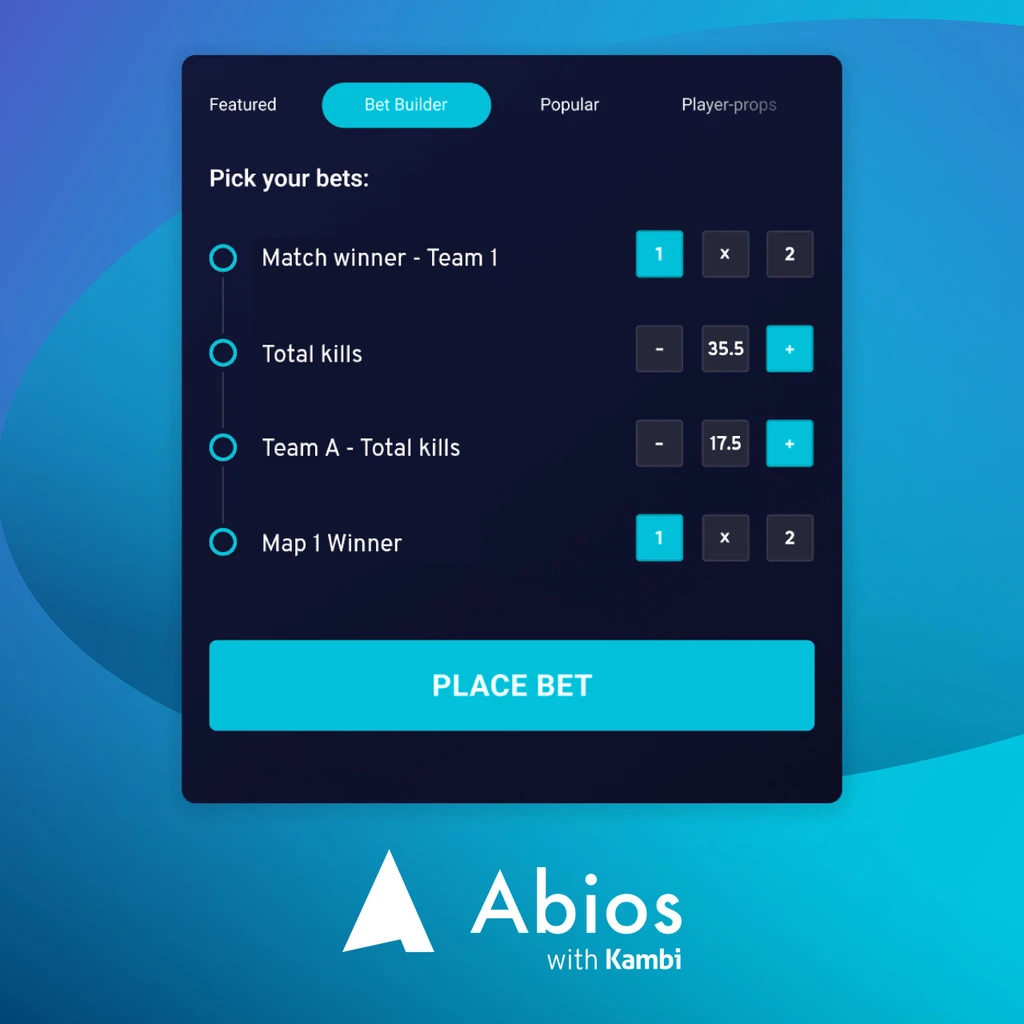
“That level of sophistication keeps audiences engaged while setting a new benchmark for product depth.”
Beyond odds, modelling and live data, presentation matters. Abios has built a unified product suite with consistent functionality across all titles, ensuring bettors experience the same visual quality and responsiveness regardless of the data source while giving operators the flexibility to build bespoke user experiences true to their established brands. This coherence is a key factor for digitally native users who value usability and consistency.
On the operational side, compliance and integrity are integral to the product. Bettors must have total trust in the integrity of an event if they are to place a bet on it, and Kambi’s 24/7 sportsbook control team applies the same monitoring systems used in its traditional sports portfolio to identify irregular betting patterns, helping to protect events from manipulation. This process is heavily supported by the extensive data sets Abios provides, enabling automated event filtering and jurisdiction-specific compliance checks that reduce manual workloads and scale regulatory adherence.
Global growth and the LatAm connection
For those limiting their view to Europe, there’s now a far greater market on the stage that will drive esports into its next phase. LatAm is proving to be one of the world’s major drivers of esports’ growth, given its significantly digital-native population and a strong, pre-existing culture of competitive gaming built on free-to-play titles. For operators, esports offers an immediate way to engage a large, as yet untapped audience that may not have traditional betting pedigree.
A recent partnership with Brazilian fantasy operator Rei do Pitaco showcases that reach, with Kambi’s esoccer product, which covers more than 20,000 matches each month, powering Rei do Pitaco’s fantasy esoccer offering. The collaboration reflects Kambi’s modular approach, positioning esports alongside products like Odds Feed+, Bet Builder, and Front End within a portfolio designed to suit different operator strategies. “It underlines the adaptability of our esports offering,” Janér notes, “and highlights how it complements diverse sportsbook models.” Kambi partners are also able to straightforwardly expand their coverage with different sports through one integration, delivered through the provider’s Odds Feed+ API.
Esports’ popularity in LatAm predates regulation, and Brazil remains a focal point. The country ranks third globally for active Counter-Strike players, with mainstream sports icons including professional footballers Neymar and Casemiro boosting visibility by investing in esports organisations and publicly backing their favourite teams.
Kambi’s footprint in the region extends beyond Brazil, powering Colombia’s two market leaders BetPlay and RushBet, and operating in Argentina, Mexico, and Peru. While Brazil’s regulatory rollout has faced hurdles, esports have proven a crucial revenue driver, with Kambi partners such as BetMGM, BetWarrior, KTO, Stake, and Rei do Pitaco all taking advantage.
Data holds the key to unlocking scale
We’re now in an era of adapting or being left behind, and with esports offering an increasingly significant opportunity for revenue diversification. Kambi was arguably ahead of the curve with its Abios acquisition back in 2021, and the company has continued to invest in the product. This effort means expanding coverage, refining existing features, and leveraging the sheer scale of the Kambi network – which now supports more than 50 partners and processes over $17 billion in annual liquidity.
This scale provides a data advantage that drives continuous improvement across pricing models and product development. Few competitors, Janér suggests, can access that level of behavioural and transactional insight to inform their strategy.
“Over the next five years, esports will evolve into a mature, data-driven sports vertical with betting experiences that rival — and in some cases surpass — those of traditional sports.”
“Our technology is designed to deliver an ultra-low-latency experience that allows bettors to engage with confidence and precision,” he says.
For suppliers, the direction of travel in esports is clear. It is evolving into a fully-fledged, data-led vertical defined by reliability and innovation. “By combining Abios’ deep data portfolio, proprietary modelling, and esports expertise with Kambi’s scale and infrastructure, we’re helping define how the next generation of fans will experience wagering,” Janér concludes.
“The line between esports and traditional sports betting is disappearing – and we intend to stay ahead of that curve.”

Anton Janér, founder and managing director of Abios
Esports betting is no longer a side act in the sportsbook world. Once thought of as a niche add-on, it’s now rivalling traditional sports in both volume and visibility. As audiences expand and technology advances, the industry is witnessing a clear mandate for data-driven, high-quality products, a shift exemplified by Kambi and its subsidiary Abios’ ongoing investment in a comprehensive esports offering. Anton Janér, founder and managing director of Abios, shares more.