
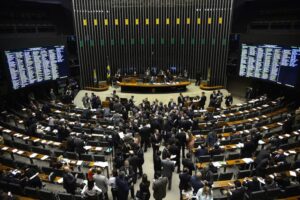
On Wednesday (27), government representatives and the sports betting sector stated that banning bets on individual events during matches—such as cards, corner kicks, and fouls—could drive more bettors into the illegal market. As reported by Agência Câmara de Notícias this restriction is outlined in Bill 2842/23 and was discussed by the Permanent Subcommittee for the Regulation of Sports Betting, linked to the House Sports Commission.
Representing the Ministry of Finance, Leticia Soeiro noted that while the bill, authored by Deputy Ricardo Ayres, could reduce the risk of fraud related to match-fixing, it might also diminish interest in the legal market regulated by Law 14,790/23.
“This is a point that we need to analyze very cautiously. As regulators, our job is to mitigate risk by requiring companies to have prevention policies against manipulation and to demonstrate a connection with an independent entity monitoring sports integrity,” said Soeiro, who is the Coordinator for Responsible Gaming at the Secretariat of Prizes and Bets (SPA).
Gabriel Lima, executive director of the football team alliance Liga Forte União do Futebol Brasileiro, cited studies from Belgium and the UK showing that strict restrictions push bettors towards the illegal market. He also expressed concern about sponsorship contracts, noting that nearly 100% of clubs in the A and B leagues financially rely on betting companies.
Rafael Marcondes, president of the Association of Bets and Fantasy Sport (ABFS), stated that 90% of match-fixing cases are linked to the main betting market (final match results), while the secondary market (corner kicks and cards) accounts for only 13%. He emphasized that manipulation is a global issue that cannot be addressed solely with local measures. “Even if Brazil forbids these bets, they will continue to happen on international sites,” he said.
Meanwhile, Tiago Barbosa from Genius Sports highlighted that between 70% and 80% of bets in Brazil occur in illegal markets. He noted that restrictions in the regulated market would affect only 20% to 30% of the total.
The national secretary of the Ministry of Sports, Giovanni Rocco Neto, stated that efforts should focus on illegal operators. “The issue of betting cannot be resolved by just pressing a button. The only way forward involves technology to block and trace the money from illegal houses, as well as police action, because criminals are cautious about law enforcement.”
The hearing also discussed advertising, sponsorship, and the impacts of gambling addiction. Deputy Caio Vianna who suggested the debate, questioned the Ministry of Health about the low number of treatments for individuals with a dependency on digital betting.
Marcelo Dias, director of the Department of Mental Health, Alcohol, and Other Drugs, explained that most dependents do not seek health services, and many only come through family insistence or professional intervention. He stated that the ministry’s focus is to integrate the issue into mental health policies, especially in primary care, without treating it as an individual weakness.
Caio Vianna also advocated for more responsible advertising by companies. “Betting companies need to take responsibility for educating the Brazilian population. And what better way to educate than through their own advertising, showing that they care about more than just increasing profits.”
The post Brazilian Chamber of Deputies discuss ban on betting on events during matches appeared first on G3 Newswire.
On Wednesday (27), government representatives and the sports betting sector stated that banning bets on individual events during matches—such as cards, corner kicks, and fouls—could drive more bettors into the illegal market. As reported by Agência Câmara de Notícias this restriction is outlined in Bill 2842/23 and was discussed by the Permanent Subcommittee for the…
The post Brazilian Chamber of Deputies discuss ban on betting on events during matches appeared first on G3 Newswire.