
“We say internally, ‘We’re not your grandad’s or pop’s bookie’,” remarks Nick Wright, the 34-year-old American co-founder of Midnite, a venture capital-backed challenger disrupting the UK market’s status quo. What was previously quoted at Midnite to inspire the team to build the next generation of products, is now embedded in the operator’s marketing efforts. For example, ‘We’re not your grandad’s bookie’ and Midnite’s logo periodically flashes across the pitchside LED advertising boards for the 2025-26 season at Championship clubs Sheffield United and Southampton.
The message is largely about informing young Millennial and adult Gen Z football fans that there’s an alternative to what they might consider to be a staid carousel of legacy retail and dotcom-era bookmakers. “We have a recipe I don’t think anyone else has in the UK – it just resonates with that audience,” insists Wright, who is decked out in a long-sleeve T-shirt, loose-fit jeans and white trainers for a photoshoot and interview with EGR in London’s Whitechapel.
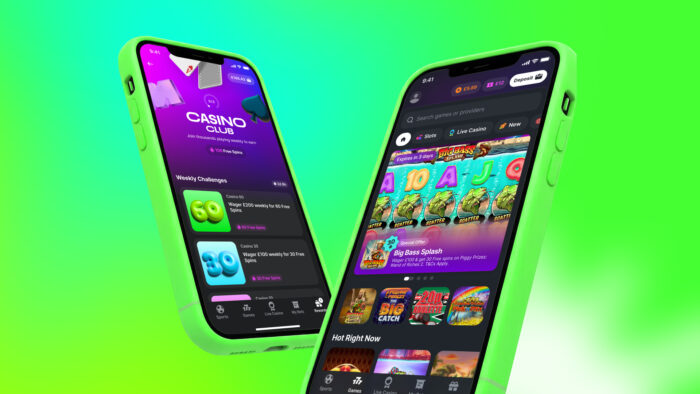
One of the main ingredients in that recipe is Midnite’s proprietary tech stack. It’s a differentiator Wright and fellow founder Daniel Qu, who both have product and tech backgrounds, are especially proud of. “We’re a modern product built on modern technology and a modern platform,” explains Qu, who was in the US at the time of the photoshoot, so we spoke over Teams at 6am Pacific Time in late August.
“Our potential for innovation is greater than any of our peers and any of the companies we aspire to grow to [in size]. It’s not a bold statement – it’s just factually the case that our foundation is different to the vast majority of our peers.”
The in-house product hasn’t gone unnoticed; Midnite finished 10th out of 20 operators on its debut in boutique analyst firm Eilers and Krejcik Gaming’s H1 2025 casino app testing report for the UK market. The operator was one of the top performers for UX and ‘Play’ (breadth of content, game load times and stability).

Wright says just being included in the report is an “incredible milestone” for a casino product the team unleashed less than two years ago. “We’re very much here now, but this isn’t good enough,” he admits. “We know the product is not good enough, but this is just the beginning […] by the next [report] our ambition is to be top five, if not top three, and over the course of the next 12 months the goal is for us to be in the top spot.”
While it sure is a bold target, Wright feels there are opportunities to push the boundaries with casino, particularly the lobbies. “We’ve all been pretty complacent – putting thumbnails on a landing page.” Moreover, it’s about serving up the best possible customer-first experience. “We’re not perfect – we’re still early in our journey […] but we’re ruthlessly obsessed about delivering experiences, whether you’ve triggered something and need to upload a doc to verify your identity, or a casino game with instant load times. We want to be the fastest and most exciting betting app where everything just works.”
Crunch time
Midnite’s founders grew up 15 minutes from one another in San Diego, California, though their paths didn’t cross until their early 20s. It was 2013 when they met, at a startup- and entrepreneur-focused TechCrunch conference organised in their home city. They were introduced by mutual friends and immediately hit it off. Wright had not long exited an outdoor clothing company he’d founded when he was only 17 and was putting his self-taught frontend web design skills to work by dabbling with creating mobile apps. Qu had graduated from Yale University in Connecticut, where he’d studied computer science and economics.
Witnessing his classmates and Yale alumni launch tech startups ignited a desire in him to do something similar. “Just that concept of imagining something and then being able to build it yourself, that really appealed to me,” Qu shares. It was roughly a year after that initial encounter that Wright and Qu teamed up to build mobile apps. This was the era when Flappy Bird, a side-scroller mobile game created in a few days by a Vietnamese programmer, had become a global phenomenon.

The duo naturally fell into clearly defined roles: Wright concentrated on UI and UX, and Qu was the engineer. “Can we build a cool product that people will use?” Qu recalls. “That was the premise, rather than needing to build a business that makes money.” Together they ended up crafting a news aggregator, Pilot Reader, and video-sharing app Juice Video. “Nothing that was supposed to be a company,” Wright remembers.
From there, the focus switched to ideas that would “monetise right away”, Qu says. Seeing as they both played daily fantasy sports (DFS), a mobile-only DFS product was their next plan. Yet it should target the UK market instead of trying to compete with FanDuel and DraftKings in the US.
Realising they needed to be on the ground in the UK for this next project, Wright and Qu, both 24 at the time, packed their bags and hopped on a plane from San Diego to London. “Thinking back now,” Qu reminisces, “we were quite naive in terms of buying plane tickets and flying to the UK to build a product in one of the most regulated markets in the world with some of the fiercest competition.” Nevertheless, they rented an Airbnb in Kennington and during the working day decamped to a Starbucks situated in the shadow of the railway station in Vauxhall.
Hunched over laptops and fuelled by shots of caffeine, the pair managed to build an alpha version of a five-a-side football DFS product they christened Dribble. In the summer of 2015, friend Rupert Brenninkmeijer came onboard to take charge of marketing and growth, while angel investors stumped up seed funding to get Dribble off the ground. The product soft-launched on iOS ahead of the 2015-16 Premier League season.
App Store reviews were glowing; early adopters praised its “simplicity and interface” and the “beautifully intuitive design”. Dribble soon gained a loyal community. However, achieving meaningful scale and revenue turned out to be a tough slog, even with an exclusive deal struck in 2017 with Sky Betting & Gaming (SBG), which saw Dribble’s product fully integrated into the tier-one operator’s platform.
While free-to-enter season-long fantasy football was, and still is, extremely popular in the UK, the concept of DFS and putting money on the line was an alien concept for many. Also, a primary reason DFS exploded in the US in the early to mid-2010s was because legal sports betting didn’t exist outside Nevada prior to PASPA’s repeal in 2018. The UK, however, offered the full gamut of legal sports betting and igaming.
“As a standalone product, it was never going to be competitive against your full sportsbook or casino products in the UK,” Qu acknowledges, while emphasising there is “a delta” between the lifetime value (LTV) of sportsbook and casino customers versus DFS users.

Wright concurs: “Fantasy, whether free-to-play or real money, is just [good for] engagement and retention, or acquisition. We had great CACs [customer acquisition costs], but to monetise a fantasy product in the UK you need to have that funnel, right? You need to have the entire ecosystem of sportsbook, casino and everything.”
The experience gained with Dribble, plus being able to peek behind the curtain at SBG, encouraged the two entrepreneurs to switch tack and launch an online betting business. For Wright, the UK was the “perfect environment to disrupt”, so they started building a dedicated esports betting platform that would become Midnite.
Esports betting startups were sprouting up in the 2010s to cash in on the esports craze and the investment being ploughed into professional teams and prize pools. Unikrn (acquired by Entain in 2021) was one of the trail-blazers, while Rivalry soft-launched in 2018 and Luckbox arrived on the scene the following year.
“We weren’t looking at a long-term angle at that point,” Qu affirms, “but we thought it was a cool opportunity because there was a thesis esports could be massive or grow extremely quickly.”
With Dribble mothballed, the pair and their small team of developers and engineers set about building Midnite. Revolut, the fintech decacorn that was initially a cheap way of sending money abroad, influenced the look and feel of the product. “It was just the impressiveness of that product,” says Qu. “We wanted [Midnite] to be closer to Revolut than a high street bank app. It needed to be new and fresh.”
Launched initially in invite-only alpha mode, Midnite offered a menu of markets on matches for top esports titles like Counter-Strike: Global Offensive, League of Legends and Dota 2. The site would later display a message under-scoring the fact that it was “not another Curaçao operator” but was licensed by the Gambling Commission (GC). This ultimately proved to be a double-edged sword, however.
While the GC licence boosted the fledgling operator’s credibility with would-be investors and helped Midnite to corner this niche as an esports-centric bookmaker, the reality is betting on esports in the UK is just that: a niche. Wright expands: “What everyone’s realised [with esports betting] is you need to be in a lot of markets – and a lot of those are unregulated – for it to be a viable business.”
Another issue is that esports bettors tend to skew younger than traditional sportsbook customers, so, Wright notes, “the audience isn’t in the full income-producing years”. He adds: “If you look at the CAC to LTV, it’s just not as interesting or as competitive as a traditional sportsbook.” Having got Midnite up and running and later introduced features like Cash Mode, which allowed users to bet on their own gameplay to win cash prizes, the next roll of the dice was to gradually morph Midnite into a full-blown, multi-vertical operator.

That said, both founders refute the notion this was a pivot in the business model. The vision all along, they insist, was to lay the foundations with esports betting and “transition” to offering a traditional sportsbook and an online casino, with both built in-house. Feedback from Midnite users played a part, too, in shaping the direction Midnite should take. “We listened to our customers,” Qu confirms.
“They said, ‘Hey, I have my wallet and account with you but I’m switching accounts to bet on football, so you guys should have the whole sports-book’. Similarly, they were like, ‘You guys should have a casino’ […] we launched these verticals, and they very dramatically exceeded how the esports side of things was monetising. So, you can call it a switch but it’s just the evolution or iteration of our platform and focusing on things customers want.”
Picking up the monetisation point, Wright says: “When we launched casino, our sportsbook retention increased 5x. In a mature market like the UK, you can’t have customers leaving because you don’t offer something.”
Remote control
The reason EGR rendezvoused with Wright at a photography studio is simply down to the fact Midnite has no proper HQ for staff. Wright himself resides in Valencia, Spain, and Qu mostly works from his home in London. Being a remote business naturally widens the recruitment net and “allows access to incredible talent”, Wright points out.
That includes industry talent; two eye-catching arrivals in recent months include Zach Amin hired from Sky Bet as vice-president of sportsbook and former Flutter marketing chief Andrew Mook appointed head of brand marketing at Midnite. The company headcount stands at around 150, up from around 60 people just 12 months ago.
Despite the surge in staff numbers, Midnite retains a lean and agile mentality, as Wright explains: “Most of the growth has been delivered by our original 12 engineers, versus competitors where you’re talking 200-plus engineers. We believe in the ‘startup land’ of keeping things small and making faster decisions.” External investment has continued to steadily flow into business, too.
Noteworthy capital injections include an early 2020 seed round of over $2.5m led by venture capital firm Makers Fund and angel investors, including Betfair co-founder Andrew Black. Two years later came a $16m Series A round led by The Raine Group, a merchant bank focused on tech, media and communications. Most recently, in April this year, Midnite closed a $10m Series B round, taking its total funding to approximately $38m.
The latest raise is being deployed to “get more resource in on product and just build, build, build,” Wright insists. Las Vegas-based investment firm Discerning Capital participated in the Series B, with co-founding partner David Williams joining Midnite’s board of directors. “One thing that led us to be really intrigued by Midnite was they were running counter to what I perceive to be the prevailing opinion about the UK market,” he recounts to EGR from his Florida home.
To paraphrase, Williams suggests Midnite is trying to shake up the UK market through product and innovation, yet the diversified gambling groups with their reliable, cash-generative UK arms have become distracted by “shinier objects”, as he puts it. Brazil being one example, he says. “From our vantage point it feels like a lot of the bigger groups have decided the right use of capital is to reinvest elsewhere rather than the UK market.”
If true, these diversions create potential opportunities for challenger brands. During the first half of 2025, Midnite has certainly elevated its profile with a flurry of marketing-related announcements. In March, the company made its TV ad debut with a campaign to promote the casino product, while a deal was announced the following month that saw Midnite become a sponsor Sky Sports News and promoted on Sky Sports Racing. Also in April, Midnite was unveiled as the official betting and casino partner of the World Snooker Championship, with all 17 days of the tournament screened either on the BBC’s TV channels or digital platforms.
Not done there, the firm also sponsored Channel 5’s coverage of football’s FIFA Club World Cup this summer, while partnerships were struck this June with Southampton and Sheffield United, the latter of which includes front-of shirt sponsorship. “We are very ROI-driven across all departments, but especially marketing,” Wright states.
“If you look at why customers bet with an operator, brand and generosity are huge components. There’s so much headroom for us to push into that. It’s intentional that the assets we’ve been looking at marry up with the audience and the brand we’re trying to build. But it’s done in a way that gives us a lot of reach and good media value at a price you know the ROI is there.”
Blood, sweat and tiers
The founders say this privately owned challenger has achieved around 10x growth in net gaming revenue year on year. Meanwhile, internal analysis estimates its UK market share to be around 1% for sports betting and 1.5% for casino. And that’s with the casino only having launched in November 2023.
“To grow to 1.5% market share in that period, we think is quite a feat,” Wright says, adding that the initial launch involved fewer than 10 engineers, at a time when they were also building out the sportsbook and regulatory tech. The next target is to surpass 5% for both verticals. “I’m confident in saying we are the fastest-growing UK gambling business, especially those past 12 months,” Wright insists. Long term, the aspiration is to become a tier-one operator. In other words, compete among names like Sky Bet, bet365 and Paddy Power. It’s a lofty ambition, but one Wright describes as the team’s “North Star”.
“We’re going to attack that and keep our foot on the gas to pursue a rapid ascent. We think there’s a 12- to 24-month window in the UK where market dynamics are shifting and this is our opportunity.” Though he refrains from putting a concrete timeline on reaching that coveted tier-one status, Wright says the team is “obsessed” about turning Midnite into a “£300m, £500m-a-year business in the next two to three years”.
He is confident the investors they have on board and the chance to raise additional capital are key to scaling the business and delivering the products and features customers want. On that note, Qu says: “In the next five years, if we’re able to ship one feature a month compared to one feature a year on average for the rest of the industry, that means we’ve got 60 features compared to another company’s five. In any industry, that’s meaningful […] I don’t know if it will come true – we could launch half that, 30 features, compared to the five, but features done excellently. It’s not only the quantity – it’s the quality.”

The business being underpinned by these in-house capabilities was a standout factor for Williams at Discerning Capital. “In our assessment, they are winning through product,” he remarks. “They have a fundamentally more flexible and innovative technology platform, so they can build new things faster than somebody sitting on a 20- or 30-year-old tech stack duct-taped and bubble-gummed together. We think that advantage naturally compounds over time.”
Midnite’s international expansion is on the roadmap, but that’s some way off in the distance. Instead, the founders’ focus remains resolutely fixed on the UK and iterating the product and appealing to that recreational Gen Z and Millennial bettor seeking out a fresh alternative. And despite the country’s increasing stringent regulations, as well as the prospect of tax hikes in this November’s Autumn Budget, Wright still spies opportunities in what he calls an “incredible market”. Borrowing a line from a quote by US investor Warren Buffett, he remarks: “We’ve always had this view that we should be greedy when other people are fearful.”
Given Midnite’s growth and the fact consolidation is a common industry theme, have there been any approaches for the business? Wright’s response to this question is that Midnite is “definitely on the radar” of potential acquirers but there is no intention to sell. Nor is he thinking about the possibility of a future IPO. “We are heads down building – I think there’s a lot of value to 3x or 5x the company over the next two years.”
And both founders remain very much hands-on with the tech and product, Wright reveals. “I’m still designing and I’m still in pixels. That is our DNA […] Daniel and I are still very much in the weeds.” Qu says: “It’s an ambitious group of people here and, yeah, we want to build something cool and something that customers genuinely love.”
Looking back on what the duo has achieved since first partnering up to build apps, Wright describes it as an “up and down journey”, though their entrepreneurial spirit and the natural resilience associated with a certain six-legged pest, has been – and remains – critical.
“There were plenty of opportunities to throw in the towel. But it’s about being a cockroach and staying alive. The main takeaway is to never give up – keep grinding, keep building and focus on what you know is going to work,” he concludes.
The post Nite vision: Midnite’s founders on their ambitious quest to reach tier-one status first appeared on EGR Intel.
Nick Wright and Daniel Qu believe their venture capital-backed challenger brand is the UK’s fastest-growing operator, largely driven by in-house product, a high-profile marketing push and recent senior hires. But, they tell EGR, this is just the beginning…
The post Nite vision: Midnite’s founders on their ambitious quest to reach tier-one status first appeared on EGR Intel.