
PENN Entertainment has reported a Q2 2025 adjusted EBITDA loss of $62m for its interactive arm, as the ESPN Bet operator continues to edge towards getting into the black for a quarterly reporting period.
Losses shrank from Q2 2024’s $102.8m and fell quarter on quarter from Q1 2025’s loss of $89m.
Revenue for the digital segment rose year on year (YoY) from $232.6m to $316.1m, although that did include a tax gross up of $137.9m.
PENN’s shares were down a little more than 2% to $17.02 in pre-market trading in New York.
Bosses said that both online sports betting and online casino delivered record revenue performances during the reporting period.
ESPN Bet is live in 20 US jurisdictions, while theScore Bet operates in Ontario. PENN also has online casino in four US states, plus the aforementioned Canadian province.
Management added that online average monthly active users (MAUs) during Q2 came to 487,000, up on the 465,000 in Q2 2024.
However, there was a dip versus Q4 2024 (542,000) and Q1 2025 (560,000), although that six-month period included the 2024 NFL season.
PENN said: “Average MAUs in our interactive segment have stabilised over the past few quarters and increased on a year-on-year basis in Q2 2025. Average revenue per MAU has also been on an upward trajectory since launch [of ESPN Bet in Q3 2023].”
Looking at online casino, where PENN has rolled out standalone apps for its Hollywood Casino brand, the firm said the performance was encouraging.
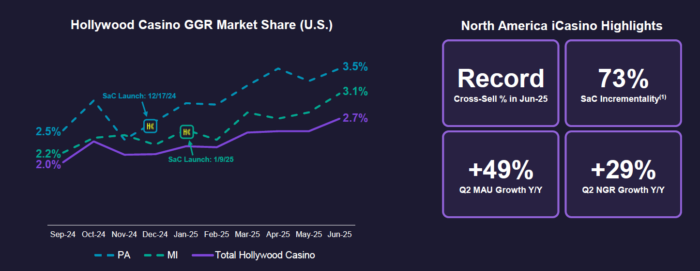
There was record cross-sell in June for sports customers into icasino, while there was a 49% increase in MAUs in Q2 and a 29% jump YoY in net gaming revenue (NGR).
Since the standalone Hollywood Casino app launched in Pennsylvania in December 2024, the brand’s market share has hit 3.5% based on gross gaming revenue (GGR), the earnings report revealed.
There was a similar story in Michigan, where market share has climbed to 3.1% since the app was pushed out in January.
On the online sports betting front, PENN announced the addition of FanCentre this month, as part of a personalisation push ahead of the football season.
Rumors continue to swirl over the future of ESPN Bet, with a three-year break clause between PENN and ESPN parent company Disney looming in 2026.
Yesterday, Disney confirmed it had sold a 10% stake in ESPN to the NFL in return for greater access, including embedding sports betting opportunities.
Further details regarding how sports betting would be implemented to greater effect were not forthcoming on Disney’s earnings call yesterday, 6 August.
The company added: “We continued to enhance our OSB [online sports betting] offering by introducing unique and engaging features such as Player Insights and favourites personalisation, while adding exciting new icasino content.”
Jay Snowden, PENN Entertainment CEO, said: “Record gaming revenues and operational discipline contributed to another quarter of strong year-over-year flow through.
“These results include approximately $2.9m in severance costs, incurred as part of strategic workforce adjustments that drive efficiencies while supporting a modern, scalable technology infrastructure.
“Our standalone Hollywood iCasino app is continuing to expand its reach with over 70% of its gaming revenue life-to-date (through 30 June) generated by users that are newly acquired, retail native or reactivated.
“We also recently enhanced our ESPN Bet offering by introducing engaging features such as Player Insights, which allow customers to evaluate player statistics in relation to player prop bets.
“And this football season marks the exciting launch of FanCentre, which leverages our connectivity with the ESPN ecosystem to enable players to bet on their favourite teams, players, and fantasy lineups through ESPN Bet.”
The post PENN’s Q2 results show interactive losses continue to shrink first appeared on EGR Intel.
Management points to sustained gains in online casino, with market share increasing on the back of standalone apps and the online division achieving record revenue
The post PENN’s Q2 results show interactive losses continue to shrink first appeared on EGR Intel.