
Dialling in from Greece via Teams, Robeson Reeves is speaking to EGR the morning after the night before. In what was a somewhat surprising M&A move, Greek firm Intralot announced it was to acquire Bally’s International Interactive in a €2.7bn cash-plus-stock deal. Reeves, Bally’s current CEO, will become the boss of the combined business when the deal concludes in Q4.
This is another step up the career ladder for Reeves, a Gamesys stalwart who got the top job at Bally’s soon after it snapped up the UK-facing, igaming-first brand a few years ago. Now, he is setting his sights on a combined entity with a vastly improved geographical penetration.
And while Bally’s International Interactive derives most of its revenue from the UK, after it slimmed down operations by disposing of its Asia-facing assets last year, Reeves is bullish on the future. He plans to continue to attack the UK but also revealed a new focus on Southern Europe as his next port of call.
The marrying of the two businesses will be key to future success. No official synergies have been disclosed. The CEO remains confident that the two somewhat unlikely bedfellows will soon cement its place towards the top of the operator food chain.
EGR: Intralot doesn’t seem, on paper at least, to have been the most obvious candidate to acquire Bally’s International Interactive – what were the driving factors from Intralot’s point of view for this acquisition?
Robeson Reeves (RR): This essentially makes a global igaming and lottery giant, as well as a real champion for Greece since we’re maintaining our Athens listing. That’s important to us because we truly believe that it’s important to be a valuable entity within whatever exchange you’re on, and it makes us one of the largest listed companies in that entire market.
Our tech platforms are exceptionally complementary. Every market is about having a good relationship with the regulator. So, we’ll be 100% regulated. We, as Bally’s, were interested in this transaction for the footprint that the lottery business had, and Intralot were interested in Bally’s because of some of our technologies.
EGR: Could you touch further on how the two businesses will be complementary to one another?
RR: It came together very nicely. And when you look at the businesses we combined and check at the numbers from 2024, you will see a combined EBITDA of €416m. That stands at approximately just over 38% EBITDA margin, with free cash flow generation in excess of 90%, and we have both consistently shown growth along those pathways.
This is a very robust, rapidly deleveraging business that should be very attractive to investors and to us because we have two models: B2B, which is very stable and well-protected against tax changes and so forth, and B2C, which can be much more lucrative, although it tends to take longer to grow to the high margins and high profitability.
I like the different economic shapes of these two businesses, and I believe it will put us in a really strong position.
EGR: What obvious synergies are there, and how will it affect Bally’s International Interactive operationally on a day-to-day basis? Does much change?
RR: We’re always evolving the business. Much of our synergies are related to consolidation of technologies, not necessarily consolidation of people. So, technologies where you have economies of scale with suppliers of content and so forth.
The world [post-]Covid has meant you have more remote working so some of our infrastructure, office space, etc, you don’t necessarily need as much because people aren’t in as often.
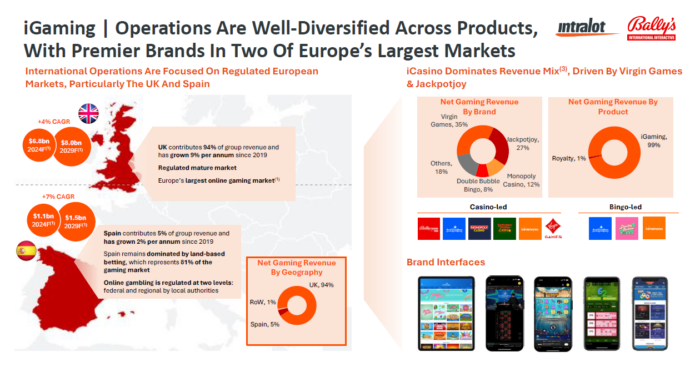
I’m more interested in the revenue synergies, where Intralot has a great PAM footprint, and I think we can use that and go into other countries because we, as Bally’s International Interactive, are so concentrated on the UK market that diversification will be of value to us.

EGR: Regulus Partners wrote that Bally’s International Interactive is “over-exposed to the UK from a risk perspective after the loss of Asia and limited expansion elsewhere”. Are you over-exposed to the UK, because Regulus estimates it to account for 90% of the division?
RR: It is a significant part of the revenue. I look at the UK and consider it our most robust market. It’s been our most reliable market for growth consistently, and having a strong regulator very much creates barriers to entry.
Our business model has no real reliance on high-value customers, so we have a very sustainable business. People can spend with us forever, which means we continue to grow over time. [As for] the ‘over-exposure’, I wouldn’t consider it that. I would say that I want to make money in more territories, but I do not see risk in the UK market. I see continued growth there.
EGR: What is the reasoning behind the growth in the UK, especially with increased regulation? Where are the opportunities still in this mature market?
RR: It happens because we have sustainable players who don’t spend more than they can afford. The regulatory environment means that you have a business that should consistently grow and have a loyal user base that stays with you in the long term.
You might have [a negative] opinion of the UK regulator. [I personally think] the UK regulator has done a great job because they have focused on ensuring the regulated market stays large and the unregulated market doesn’t grow. They haven’t caused significant displacement and have no intention of doing so. They want to make sure that every player plays within the perimeter of the regulated market. I’m probably the one person who would never say a bad word about the Gambling Commission because I think they have done a fantastic job.
EGR: In terms of the tech platform integrations, are there any plans for how that is going to work? Will Kambi, which you use in the UK, be swapped for the Intralot sportsbook?
RR: We’re viewing sports as a mean to access a larger TAM. For the UK market specifically, we look at sports to double our TAM. We will be introducing more welcome offers so we can attract a different cohort, as the current majority of our player base is female.
I would also say that we want to run fast rather than say we’re going to be neat and integrate everything together. This is about getting access to more markets from a B2C perspective but also enriching the lottery offering in B2B.
EGR: It has also been a little over a year since sports betting was introduced in Bally’s UK offering, firstly with Jackpotjoy. How do you reflect on the launch and performance?
RR: We have much more space to run. As a pretty much purely igaming operator, and with the introduction of things like stake limits in [online] slots, you have to balance your ecosystem out.
In slots, you have a £5 stake limit and a £2 stake limit for under-25s. If you can’t get that balance right, which is why we’ve carefully introduced sports, it’s going to be a challenge for an operator to manage their revenue appropriately.
We’re very careful. We didn’t want to disrupt [operations]. The business we have in the UK is pretty big, but it is just with igaming. We wanted to gradually introduce sports because our objective is to have consistent, solid growth. Yes, we’re going to always try and push to have the highest possible growth, but I would never generate risk in our business. I’m happy with where we are. We will keep on leaning more into sports in the UK, but we want to expand into other territories as well.
EGR: Could you explain a bit more about cross-sell opportunities in lottery as mentioned when the deal was struck? Is Intralot looking to set up charity or society lotteries in UK?
RR: We are looking at a charity lottery in the UK, which we see as a sensible opportunity. But in respect to cross sell, there may also be opportunities across our retail and digital footprints. We have to think that we have lottery, igaming, sports as well as retail and digital, which is actually very interesting.
EGR: Are there any smaller markets outside of the UK that are exciting you at the moment for Bally’s International Interactive?
RR: If you look at the B2C space, Spain’s currently growing quite solidly for us in the 20+ growth rate. That’s really because of the reintroduction of advertising. But if you’re going to choose a market which is more concentrated to sports than the UK, then Spain and a lot of Southern Europe are more concentrated to sports, [and] we don’t have sports there.
We will be introducing sports through the course of this year into Spain to allow us to access a broader audience. I’m all about broadening audience, adding scale and making sure our solution can be distributed on a much wider scale. I take the strength of the UK being probably the richest and most mature regulated market as a way to make sure that when we access other regulated markets, we already know where the pathway is going, and we already have all those capabilities.
EGR: Finally, could this deal be viewed as a form of the shackles coming off for Bally’s International Interactive, having previously been part of the US-facing Bally’s operation?
RR: You have Bally’s Corporation on a US listing in different capital market, and you have the group listing in a different capital market that will allow us to access two different vehicles for expansion.
So, for me, wearing both hats, this allows both businesses to go as fast as possible and expand as quickly as possible. I think it positions Bally’s/Intralot as an entity, which would also have the ability, if the circumstances were right, to look at M&A opportunities as well.
The post “We want to run fast”: Bally’s CEO on the Intralot acquisition and becoming a giant first appeared on EGR Intel.
Robeson Reeves, Bally’s CEO and soon-to-be Intralot boss, explains to EGR the rationale behind the multi-million-euro merger and why he doesn’t consider his business’ presence in the UK as “over-exposure”
The post “We want to run fast”: Bally’s CEO on the Intralot acquisition and becoming a giant first appeared on EGR Intel.