
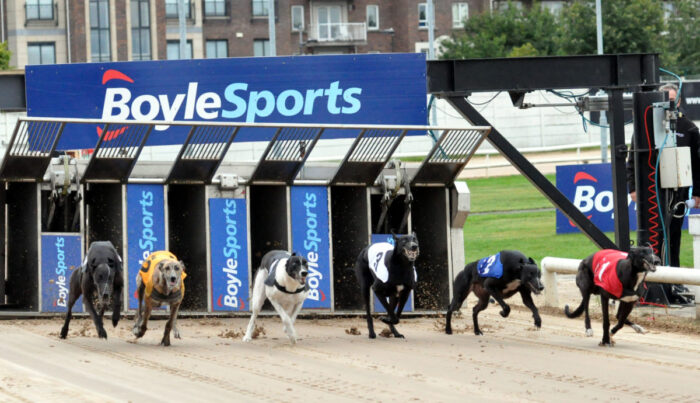
The year 1926 was particularly important in British history. Not only was it the birth year of Queen Elizabeth II, but it was also when the first greyhound racing event took place in the UK – at the Belle Vue Stadium in Manchester on 24 July, to be precise. According to the University of Huddersfield’s professor Keith Laybourn, author of Going to the Dogs: A History of Greyhound Racing in Britain, 1926-2017, the sport’s popularity blossomed among the working classes to the point that it spawned over 200 tracks a decade after its Belle Vue debut.
Today, there are just 19 registered tracks in Britain, licensed by the Greyhound Board of Great Britain (GBGB). They’re evenly spread across the country, from as far north as Newcastle to as far south as Brighton.
Not only has greyhound racing’s popularity waned over the years, but it faces increasing pressure around welfare concerns. In February of this year, the Welsh government announced plans to ban the sport entirely as soon as possible. This followed vociferous calls from political parties, a government consultation and a petition which garnered more than 35,000 signatures.
The demand for Scotland to follow in Wales’ footsteps is also growing significantly. Scotland Against Greyhound Exploitation founder Gill Docherty’s petition to ban the sport is the “most signed in Scottish parliamentary history”, according to the BBC, with welfare concerns being the main driving force.
A spokesperson for the lobby group Alliance Against Greyhound Racing (AAGR) tells EGR that the organisation supports the Scotland petition. The AAGR suggests that the impact of consistently racing on oval-shaped tracks causes dogs long-term damage. “It is unacceptable that greyhounds, which are gentle, loving dogs, continue to be killed and injured to satisfy the gambling industries. Hundreds of greyhounds are killed every year from racing – 70% of all deaths in racing greyhounds are from injuries.”
Hare today, gone tomorrow?
Figures from the Gambling Commission back up British greyhound racing’s decline from a betting perspective. Disregarding the Covid-stricken period of 2020 to 2021, between April 2008 and March 2009, on-course dogs betting generated gross gambling yield (GGY) of £3.9m on turnover of £49.3m. Fast forward 10 years to the period between April 2018 and March 2019 and the figures had sunk to £1.62m and £16.5m, respectively.
For the regulator’s latest reporting period, between April 2023 and March 2024, on-course betting on greyhound racing brought in GGY of just £900,000 on turnover of £10.4m. When looking at off-course, over the counter betting, GGY slumped from £304m between 2008 and 2009 to £139m for the 2023 to 2024 period. Meanwhile, turnover between 2008 and 2024 more than halved, plummeting from £1.6bn to £794m.
Elsewhere, specifically the digital space, greyhound betting has experienced solid growth compared with 10 years ago, according to the data. Indeed, online GGY increased from £28.4m between April 2015 to March 2016, to £80.1m for April 2023 to March 2024. The sport has somewhat plateaued of late, though, after hitting a high of £81.7m from April 2021 to March 2022. Turnover – £640.6m for the latest reporting period – follows a similar pattern.
As for the sport’s funding, the British Greyhound Racing Fund (BGRF) helps support the industry, with Betting and Gaming Council members voluntarily handing over 0.6% of their turnover on dogs to the organisation. During 2023-24, the BGRF received £7.3m, down 4% from the previous year. BGRF chair Joe Scanlon acknowledged at the time the income was “disappointing but not unexpected”, citing the introduction of affordability checks as the primary reason.
Last year also marked a major shift in the broadcasting of greyhound racing, with the Entain and Arena Racing Company (ARC) joint venture, Premier Greyhound Racing (PGR), signing an exclusive broadcast deal with Sky Sports from January onwards. The deal included daily coverage of races from PGR tracks on Sky Sports Racing, with additional coverage behind Sky’s red button service. Between them, both companies own nine of the 19 registered greyhound tracks left in Britain.
Anthony Kaminskas, founder of on-course and online challenger bookmaker AK Bets and the former head of greyhound racing at Paddy Power Betfair, suggests that the sport’s current TV coverage isn’t being maximised to draw in a larger audience. “There are numerous reasons for the decline in popularity of greyhound racing,” he says.
“Dilapidated facilities, too much racing and a lack of TV coverage – losing Sky Sports [weekly evening greyhound racing switched from the main Sky Sports channels to Sky Sports Racing] was the line in the sand and it’s been all downhill since then from a popularity perspective,” Kaminskas continues.
“RPGTV’s [Racing Post Greyhound Television] recent demise feels like close to the death knell. The sport can still compete for the leisure pound on Friday and Saturday evenings but even then, that pound has been pushed outside major cities as the land some former tracks have sat on means housing is often the route to riches.”
There’s life in the old dog yet
Ben Keith, owner of bookmaker Star Sports and Star Pelaw Grange Greyhound Stadium in Durham, says claims of greyhound racing’s demise have been greatly exaggerated. In addition to his own experience as a track owner, he highlights several other examples of successful operations. “If you were to look at Romford Dogs on Twitter [X], you’d see there’s a full house every weekend. Belle Vue Stadium has great crowds. If run well, greyhound racing is very popular. It’s holding up very well, even if there are a lot of doom-mongers.”
Kaminskas agrees, while acknowledging the sport’s retail heyday is over. “When I was employed at Paddy Power Betfair from 2012 to 2018, greyhound racing would have been the third-highest turnover sport in retail,” he recalls. This is likely why bookmakers with a large retail footprint have had a particular interest in the sport – including the ownership of tracks.
“The halcyon days of retail are now behind us, which will likely see some of those corporate bookmakers focusing elsewhere. Online, the sport struggles to cut through and the competition is tougher. It wouldn’t be close to being the third-most popular sport but will still occupy a spot in the top 10,” he adds.
With demand not completely extinguished, Keith suggests sticking to the sport’s traditions will help keep the flame burning. He explains: “A local dog track must have a Friday or Saturday night meeting because that’s when the public can go. Dog racing is an evening pursuit and having morning and afternoon meetings won’t suffice.”
At the top-end of the sport, the prize money may serve as enough of an incentive to keep greyhound owners interested. First prize for the winner of the English Greyhound Derby has been an impressive £175,000 since 2021. The overall prize funds for the UK’s other major races tend to be around £20,000 for the Scottish Greyhound Derby, £10,000 for the Champion Stakes and £7,500 for the Greyhound Grand National.
Kaminskas also places an emphasis on fewer races and more TV coverage. He says: “I see zero promotion of the sport outside of the sponsors’ [Star Sports] gallant attempts with the English Greyhound Derby.” Whether or not Scotland makes good on Docherty’s petition remains to be seen, though the GBGB has initiated legal proceedings challenging the Welsh government’s ban on the sport.
“I don’t think the ban in Wales will be upheld,” muses Keith. “[The ban] was a silly crooked deal with the Labour Party and the Liberal Democrats to get one vote [to pass the 2025 Welsh budget],” muses Keith. “There isn’t a licensed dog track in Scotland. It’s total virtue-signalling and attention seeking.” Kaminskas adds: “Intellectually devoid politicians on the backbenches are always looking for a cause that they think will play well with voters. The working man and woman are often forgotten when there’s a spot of virtue-signalling to be had.”
Even if it might not be reaching the dizzy heights experienced in the 20th century, greyhound racing still has a role to play in the gambling industry, even if it is filler content around horseracing. And while the welfare of greyhounds will always be a concern, only time will tell if greater consideration will be given to the welfare of the sport as a whole.
The post Gone to the dogs: greyhound racing’s relevance in 2025 first appeared on EGR Intel.
With animal welfare concerns growing louder, as well as a decline in live TV coverage, just how high a regard is the sport held in by UK bookmakers as a betting product?
The post Gone to the dogs: greyhound racing’s relevance in 2025 first appeared on EGR Intel.