
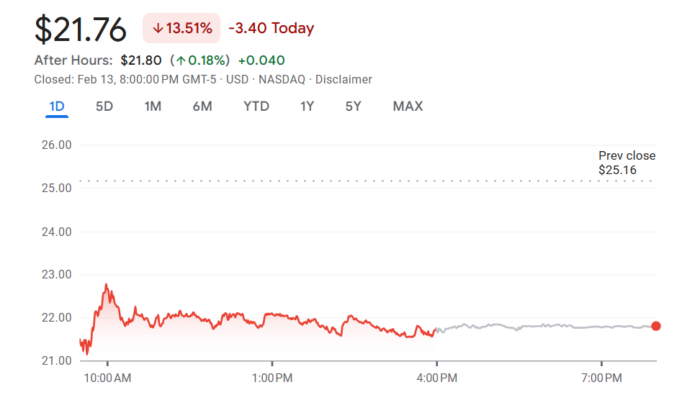
A hit to DraftKings’ share price is not what CEO Jason Robins and co would have expected following a strong Q4 2025 earnings report. Let alone two. Once the financial performance was released after-market on Thursday, 12 February, the stock slid 15% from its close of $25 (£18.32). The following day, it was below $22. The result sees DraftKings market cap sitting at $10.8bn, less than the $11bn valuation Kalshi achieved following its Series E funding round announced in December. This time last year DraftKings was worth $26bn.
Speaking to analysts on Friday’s earnings call, Robins was candid. He explained how the Commodity Futures Trading Commission’s (CFTC) insistence that prediction markets fall under its oversight had given the Boston-based giant the green light to dive headfirst into the white-hot space. He was also upfront about the full-year 2026 guidance, which triggered much of the selloff, as a more conservative roadmap for the year ahead was laid out.
With an Investor Day scheduled for 2 March, DraftKings will be hoping the market reacts more positively in a few weeks’ time. “We have a lot of exciting new things to unveil there, including our strategy for winning in predictions,” Robins said. The earnings call gave a peek behind the curtain, as detailed here by EGR.
You are clear for launch
The latest financial report marked a shift in DraftKings’ approach to prediction markets. In fact, ‘prediction markets’ was mentioned 87 times in the firm’s 10-K filing. A year ago, it didn’t crop up once. Perhaps obvious and natural, since DraftKings Predictions went live in December, but there remains a marked change around language and outlook for a product still not totally in the regulatory clear. Robins, however, views the language from CFTC chair Michael Selig as the proverbially blessing to power ahead.
Some stakeholders still believe prediction markets end up in the Supreme Court. Of course, the likes of Kalshi and Robinhood are fighting legal battles at a state-level. But the CFTC’s insistence on fighting the sector’s corner and applying its weight to ongoing cases, will be a cause of optimism. Add in the fact sports event contracts have essentially flourished without friction under the Trump administration, and the vertical looks to be in a strong position.
Robins remarked: “I wouldn’t say it’s a change of tone as much as an acceleration of our excitement. There’s been a real lean in from the CFTC. What went from sort of a hands off, ‘we’re not going to comment’, posture from the previous interim chair to a now full-fledged affirmation that this is something the CFTC considers to be firmly under their jurisdiction.
“They intend to defend in the courts, and they’re going to issue real guidelines and regulations.
“So, anything that creates a stable regulatory environment that allows us to operate more freely is a great upside thing for us […] the biggest thing holding us back before, if you will, was the regulatory uncertainty, and that has since been cleared up.”
A market? We’ll make it
Included in Robins’ letter to shareholders alongside the earnings report, the CEO laid out how DraftKings will move into market-making as part of its prediction markets push. “Liquidity is a core part of the customer experience in predictions,” he wrote. The eventual aim, it appears, is to own the ecosystem.
Being a market-maker will save on transaction fees, while synergies derived from its existing online sports betting (OSB) playbook could be deployed. DraftKings is planning to launch market-making on Railbird – the CFTC-licensed exchange acquired last October – once it eventually goes live later this year. The operator’s 10-K report showed $84.8m was paid for the business.
Robins continued: “Virtually every market-maker out there is lining up at the door, trying to get set up for Railbird. They know we’ve come to really be aggressive. We’re going to have all the same market-makers you see on other platforms.
“I think the DraftKings market-maker is going to be a real differentiator in terms of creating liquidity, particularly in some of the new types of markets and combo-type markets we set up. Because we have the pricing models, because we have the trading desk, we have all the things you need already. We should be able to really quickly become one of the largest, if not the largest, market-makers out there.
“That gives us a huge advantage in terms of supply and liquidity, and we haven’t decided yet how many exchanges we want to operate on and exactly how we want to do that, but we’ll definitely be operating our market-maker on Railbird.”
Guidance on guidance
With the 2026 guidance giving analysts and investors some gripes, Robins lifted the lid slightly on the adjusted EBITDA forecast of $700m to $900m. In comparison, full-year 2025 adjusted EBITDA hit $620m. The boss said upcoming launches of online casino in Maine and Alberta (OSB and casino) would see dollars funnelled to those markets. However, he added that the company expects no revenue from DraftKings Predictions amid a planned investment drive. Earlier in the call, Robins said he was “targeting hundreds of millions in annual revenue for DraftKings Predictions in the years ahead”.
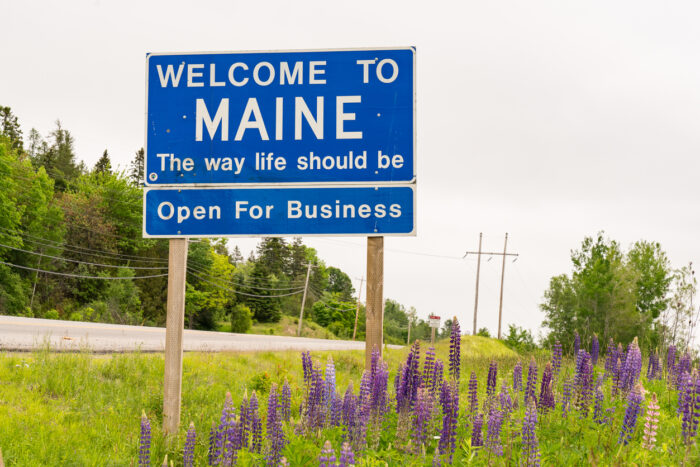
The CEO continued: “We did put Maine igaming as well as Alberta in there. There is some spend allocated to those. We don’t have an exact timing on launch yet but we feel certain enough they’re around the corner – that we were able to quantify appropriately and put it in there.
“In terms of predictions, no revenue […] is in the guide. From a spend perspective, there’s fixed costs which is double digits but not that significant. There’s mostly existing headcount that we can repurpose and there is a lot of new headcount, too. It won’t be entirely incremental. It will be tens of millions.
“We’re expecting to spend [on marketing]. There is some incremental marketing there for competitive purposes [but] I don’t want to give an exact number.”
A catalyst for change
Analysts asked Robins if he thought the acceleration of prediction markets would encourage lawmakers to fast-track OSB legislation in states without a legalised arena. As part of his response, he took aim at those states plotting further tax hikes and other charges. For instance, Michigan is planning a per-wager fee akin to Illinois, while Arizona could up its rate to 45% for the largest operators.
Robins said: “In my view, states would be absolutely crazy right now to raise OSB taxes with everything going on with predictions. So, we’re definitely getting some good traction on both that and on future legalisation.
“It’s hard to know yet because we are still in the midst of the sessions whether it’s going to make a difference in pushing any new bills over the line. But I am optimistic from what I’m hearing.
“It is definitely a point of discussion in the states, and I think something they’re taking very seriously. So, I wouldn’t be surprised if that’s the difference between getting a state or two done [by passing legislation] this year.”
Skeletal start
It is fair to say the initial iteration of DraftKings Prediction wasn’t exactly comprehensive when it launched in December. Robins himself admitted on the analyst call it was “very bare bones”. And without any major marketing push around the product, the lack of depth, at this point, was cited as a reason. DraftKings did partner with Crypto.com to add further markets like player performance, golf, UFC and politics, yet DraftKings Predictions still has some catching up to do to compete with Kalshi for breadth of markets.
On expansion and subsequent marketing, Robins noted: “When we first launched the product in December, it was very bare bones. It still is, frankly, but we’ve added a lot of over the last few weeks.
“We wanted to make sure, obviously, that we had a product we felt was competitive, which we really are starting to feel like now.
“In terms of the question around marketing, I think this is actually a huge advantage of ours. Most customers don’t really understand the difference [between sportsbook and prediction markets]. I think the national marketing footprint is a big advantage because we can drive people towards our product. I think that provides us with a tonne of leverage and synergy.”
Have Your Say
Take our short customer survey on EGR’s content and data offering for the chance to win a £100 Amazon voucher. It will take less than three minutes, with the findings used to inform our plans to improve the platform.
The post Five things we learned from DraftKings Q4 2025 earnings first appeared on EGR Intel.
News editor Joe Levy examines the New York-listed operator’s latest financial report and earnings call, as prediction markets continue to dominate the discourse
The post Five things we learned from DraftKings Q4 2025 earnings first appeared on EGR Intel.