
Football bettors don’t stop being football bettors when the final whistle blows. But for most operators, engagement does. Four to six hours of concentrated activity around live matches, then relative silence. Eighteen hours where demand exists but operators have nothing to offer the audience that generates the majority of their football handle.
World Cup 2026 makes this problem urgent. The 2022 tournament accounted for 7.2% of all sports betting stakes that year in France, according to country’s gambling regulator; one event driving nearly a tenth of yearly volume. But that demand concentrated around match windows, not across the full tournament. For 2026, the tournament’s North American schedule creates late night and early morning dead zones for European and Asian operators during what will be their highest-revenue period. Operators that solve for those gaps will capture engagement. Those that don’t will lose it to better-prepared competitors.
Over the past few years, faster markets, improved pricing, streaming and in-play tools have strengthened engagement during live matches. But before kick-off, after full time, during half time and on days when no relevant fixtures are scheduled, the calendar creates a structural constraint no amount of in-play optimisation can solve.
Generic virtual sports can feel disconnected from real football. Cross-sport promotions frequently fail to retain football-specific audiences until fixtures resume. The calendar gap isn’t just a content problem; it’s a retention problem.
Why calendar gaps cost more now
Three shifts make these gaps costlier today than they were even two years ago.
First, bettor expectations have changed. Football audiences expect the same on-demand access they get everywhere else in digital entertainment. The patience that once existed around fixture schedules is gone.
Second, live betting now represents a growing share of football handle, and engagement is tied directly to real-time availability. When pre-match dominated, gaps between fixtures had smaller commercial impact. Now, when fixtures pause, engagement drops.
Third, the competitive landscape has intensified. Operators compete not just with each other but with streaming platforms, social media and mobile gaming for the same attention. Every empty hour is an hour where bettors can drift to alternatives that don’t pause.
For operators with significant football handle, even a 10% retention improvement during gap periods can represent millions in otherwise-lost engagement annually. And the FIFA World Cup 2026 raises those stakes significantly.
Two gaps, two different problems
Calendar gaps come in different shapes and require different responses.
Some gaps are short: half-time breaks, post-match windows, tournament or league rest days. The audience is already engaged, active on the platform and focused on football. These windows need frequent, authentic football moments that fit tight timeframes and keep the football mindset active.
Other gaps are long: overnight periods, off-season weeks, time-zone mismatches. Here, the challenge is continuity. Bettors still want football content but there are no real fixtures to anchor engagement. These windows need a continuous football storyline that acknowledges what it is, doesn’t pretend to be live sport and gives bettors a reason to return over time.
Treating both gaps as the same problem usually leads to weak solutions. Addressing them separately allows more practical and targeted approaches.
Solving short gaps: when they’re already on your platform
Short gaps need compression, not substitution. The format must be fast, authentic and football-specific enough to hold attention without trying to replicate a full match experience.
Penalty Arena was designed around this constraint. An automated machine delivers penalty kicks toward a real goalkeeper on a regulation pitch, overseen by referees, with a verified outcome every 60 to 90 seconds. Before each kick, bettors vote on where they want the ball to be shot. That voting determines the target sector the machine will aim for in a transparent, verifiable way. Markets then open around whether and how the goalkeeper will stop it – by hand, by foot or whether it’ll result in a goal. Each session follows a five-round format, creating natural prop-style betting opportunities that fit the short windows between fixtures.
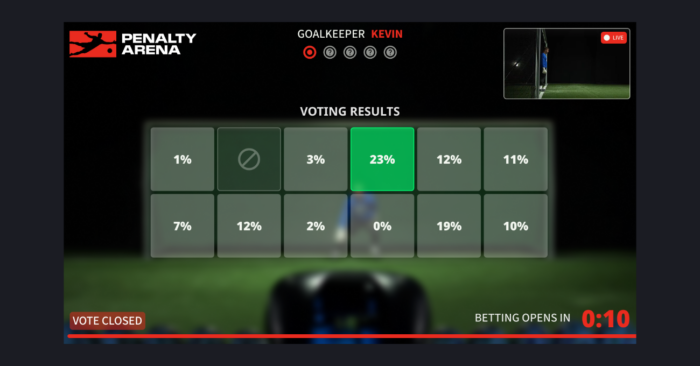
This works because participation creates involvement. When bettors influence what happens next, they care more about the result. Penalty Arena fits naturally into half-time windows, post-match periods and tournament downtime, extending football engagement into moments where attention remains high but fixtures have temporarily paused.

Solving long gaps: when live football ‘goes dark’
Longer gaps require a different approach. When no live football is scheduled for hours, the need shifts from frequency to continuity.
Oddin.gg’s eFootball format provides 24/7 player-versus-player football content that fills overnight and off-season windows. AI Avatars enhance that offering by adding an emotional storytelling layer that deepens engagement and extends sessions. Matches run around the clock at a significantly faster pace than regular matches, creating higher engagement and a more entertaining experience through emotional reactions to goals, losses and key moments. AI-driven characters react in real time to events on the pitch. Goals trigger celebrations. Missed chances create visible frustration. Controversial moments generate contextual reactions that feel specific to what just happened.

Personalities, rivalries and ongoing storylines develop naturally over time, supported by post-game and pre-game video sequences that deepen those character arcs. Bettors begin following specific characters rather than just watching isolated matches. Data from early deployments shows that when avatars are active, session length increases by 30% to 40% compared to standard eFootball formats.
This approach works best during overnight and off-season periods, providing narrative continuity during extended downtime when operators need continuous football engagement. Beyond retention, AI Avatars also serve as an effective acquisition tool, particularly through social media channels where character-driven content generates shareable moments that attract new audiences.
Engagement across the whole calendar
Operators have already invested significantly in live match engagement. Odds delivery, market coverage, streaming and in-play tooling are built around the fixture itself. The next competitive opportunity sits outside those moments.
Penalty Arena and AI Avatars address different parts of the calendar but they apply the same underlying principle: reduce the friction between wanting to engage and being able to engage in a meaningful way. One compresses authentic football moments into short, repeatable cycles. The other maintains a continuous football narrative during extended periods of downtime.
Fixture calendars are not expanding, but football demand continues to grow. In a World Cup year especially, operators that solve for the spaces between fixtures are better positioned to retain attention that would otherwise drift away. You cannot schedule demand, but you can prepare for the moments when the calendar cannot meet it.

Marek Suchar is co-founder and managing director of Oddin.gg, the leading B2B provider of esports betting solutions. With a background in finance and global business development, Suchar has helped position Oddin.gg as a trusted name in igaming.
He regularly speaks at industry events, offering insights on esports trends and how operators can build effective engagement strategies.
The post Between the fixtures: solving football’s calendar gap problem first appeared on EGR Intel.
In this article, brought to you by Oddin.gg, co-founder and managing director Marek Suchar outlines ways operators can solve the spaces between fixtures and retain bettors’ engagement, particularly in a World Cup year
The post Between the fixtures: solving football’s calendar gap problem first appeared on EGR Intel.